The Takeda: Kai, and the Battle That Is Told Wrong
Kofu, Erin-ji, Kawanakajima, and a grave you can see one day a month
Takeda Shingen ruled Kai province for thirty years and never built a castle.
He governed from a walled house on the valley floor at Tsutsujigasaki, on the principle — quoted ever since, in a poem that may or may not be his — that men are the castle, men are the walls. Whether he said it or not, the archaeology agrees with him: there is no keep in Kofu and there never was.
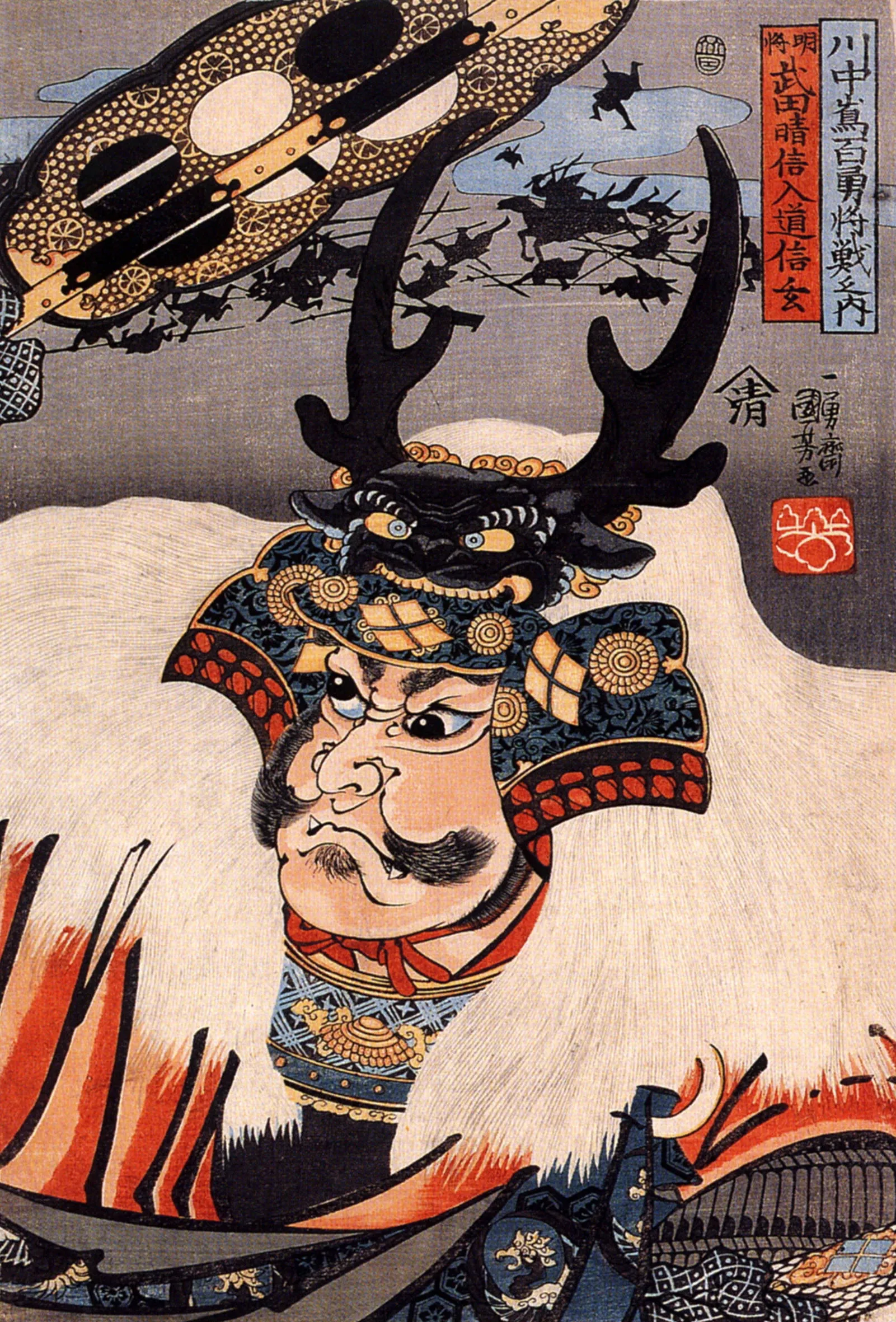
That is not a portrait of him. It is Utagawa Kuniyoshi, working in the 1840s, imagining a man who had been dead for two hundred and seventy years. It is on this page because it is honest about being an invention, which is more than can be said for the painting everyone else uses.
Part 1 — The house, not the castle
What survives at Tsutsujigasaki is the shape of the residence: the moats, the earth banks, the ground plan that archaeologists are still working through. A shrine was built over it in 1919 and the treasure hall holds the war fan.
Takeda Shrine and the Tsutsujigasaki Residence 武田神社・躑躅ヶ崎館跡
Kofu, yamanashi
The moats and earthworks of the Takeda residence, and a treasure hall holding Shingen's war fan. Excavation is still going on, and the Shingen Museum across the road explains what has come out of it.
Getting there: Bus from Kofu Station to the end of the line, about ten minutes, or half an hour uphill on foot.
What to know first: The shrine itself dates from 1919, not the sixteenth century. Shingen held Kai without building a castle, so the fortified house is the point and the moat is the oldest thing you can see.
Stand at the moat and the strategic argument makes itself. A castle on a hill announces a frontier. A fortified house in the middle of a valley says the province is already held.
Part 2 — Kawanakajima, five times
Between 1553 and 1564 Shingen fought Uesugi Kenshin on the same river plain in Nagano five times. The fourth, in 1561, was the only one that was properly a battle, and it is the one every telling means.
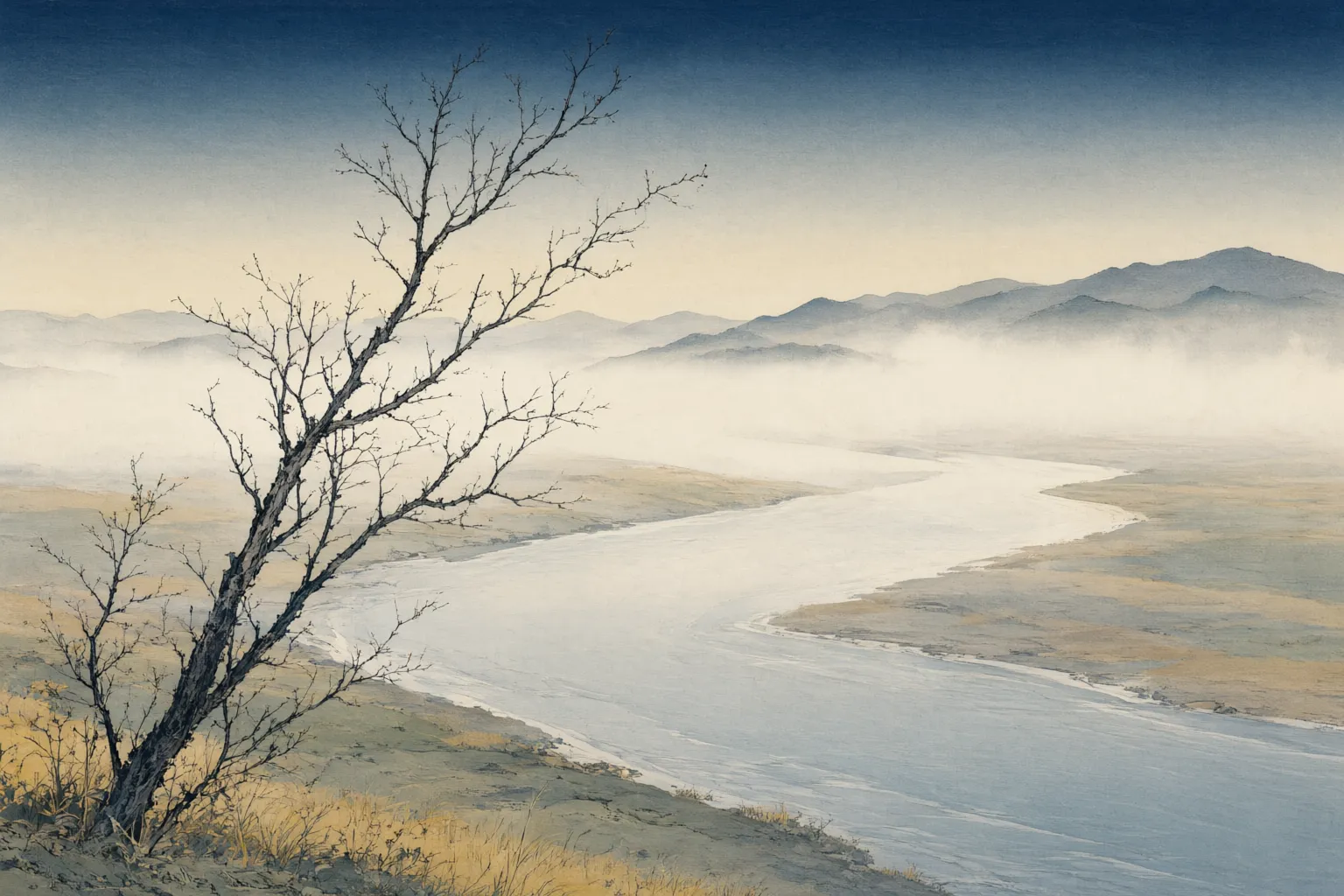

The version that gets repeated — Kenshin riding into Shingen’s command post and striking at him while Shingen parries with his iron war fan — comes from the Koyo Gunkan, a seventeenth-century compilation written long after both men were dead. It is marvellous and it is not evidence. What the contemporary record supports is a very large, very costly engagement in heavy morning mist that settled nothing: both sides claimed it, and the border did not move.
Kawanakajima Battlefield (Hachimanbara) 川中島古戦場 八幡原
Nagano, nagano
The Hachimanbara historical park, the conventional site of the clashes between the Takeda and the Uesugi.
Getting there: Bus from Nagano Station.
Part 3 — The three quiet years
Shingen died in 1573, on campaign, aged fifty-two. By his instruction his death was concealed for three years while the house consolidated — and this is where the sites get complicated, because a man whose death is secret cannot have a public funeral.
Erin-ji Temple 恵林寺
Koshu, yamanashi
The Takeda family temple, its garden designated a National Place of Scenic Beauty in 1994, with a grave of Shingen in the precinct.
Getting there: Bus from Enzan Station, about ten minutes; Enzan is on the Chuo line from Kofu or Tokyo. Open 8:30 to 16:30 all year. The temple and garden are one ticket and the Shingen treasure hall is another, around 500 yen each, though sources disagree and the fee has been revised — check on arrival.
What to know first: The grave is open on the twelfth of the month and not otherwise. That is Shingen's monthly death anniversary, and the rest of the time the tomb behind the main hall is closed. Almost nothing written in English mentions this, so people arrive on the wrong day and leave having seen the garden. Where he is actually buried is also unsettled: Erin-ji holds a grave and so does a site in the Iwakubo district of Kofu, where he is said to have been cremated and buried in secret during the three years his death was kept quiet. Both are visited as the grave.
Read the caution above before you plan the day. The grave at Erin-ji is open on the twelfth of the month, Shingen’s monthly death anniversary, and not otherwise. The garden is open daily and is a Muso Kokushi design of the first rank. But if you are going for the tomb, there is exactly one date a month on which that works, and almost nothing written in English says so.
Nine years after Shingen died, Oda Nobunaga’s army burned Erin-ji with the abbot and his monks inside it, for sheltering Takeda retainers. The temple you walk into is what was built afterwards.
Check rooms in Yumura for your dates
Part 4 — Fact and legend
The portrait: doubted. The famous painting — heavy-set, in a red robe, held at Jimyo-in on Koyasan — is no longer confidently identified as Shingen at all. A copy of it is now taken to show a member of the Noto Hatakeyama house, and specialists have been arguing about the original for years. No certain likeness of him survives. This is the third portrait on this site to have come loose from its name, after the Jingo-ji “Yoritomo” and the mounted warrior called Takauji; it is worth knowing how common this is.
The duel at Kawanakajima: retold. See above. A seventeenth-century book, not a contemporary one.
“Men are the castle”: retold, probably. The poem is attributed to Shingen and appears in later collections. The policy, though, is documented in the ground — he really did rule without a keep.
The hidden death: documented. The three-year concealment is attested, and it explains why Kai has a grave that opens once a month, a second claimed grave in a Kofu suburb, and no agreement about which is real.
Before you go
Erin-ji is open 8:30 to 16:30 all year, ten minutes by bus from Enzan. The temple and garden are one ticket and the treasure hall another, around 500 yen each — published figures disagree and the fee has been revised, so take that as an estimate rather than a promise. The twelfth of the month is the date that matters.
Takeda Shrine is at the end of the bus line north from Kofu station, about ten minutes, and the grounds are free. Kawanakajima is not in Yamanashi at all — it is outside Nagano city, two hours away, and makes sense as part of a trip toward the Sanada country rather than as a day out of Kofu.
Yumura is six minutes by car from Kofu station, which makes it the unusual case of an onsen close enough to a city to be practical and still not walkable. Six inns are bookable in English; the two worth the money are marked below.
Where to Stay: Yumura Onsen
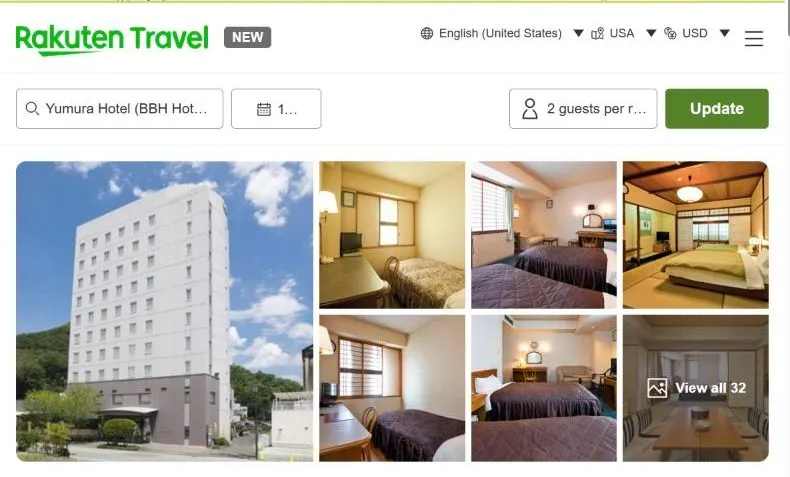 Yumura Hotel (BBH Hotel Group)from $91
The value pick: a plain hotel on the hot spring rather than a ryokan, 4.1 across fifty reviews, at a third of what the old inns charge. Right if Kofu is a base for the sites rather than the point of the trip.
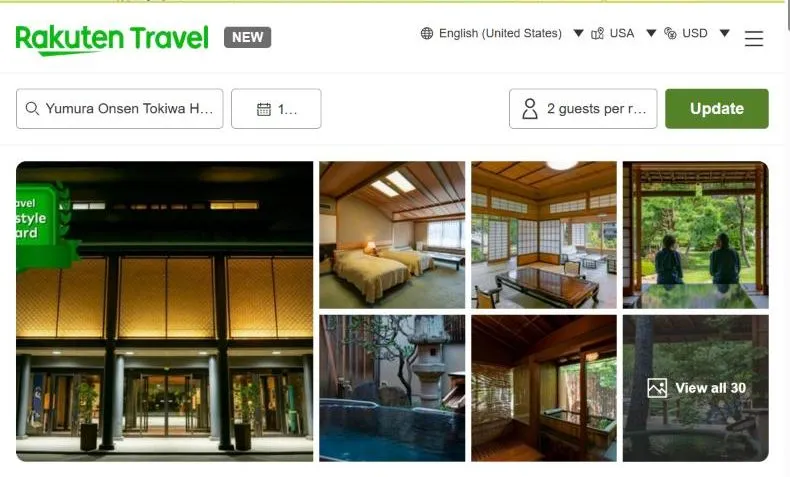 Tokiwa Hotelfrom $264
The best-evidenced score in the valley by a distance — 4.7 across a hundred and three reviews — and the grand old house of the spring, with a garden and the kind of service that gets written about. If one night of this trip is the expensive one, make it this.
Inn images are screenshots of each inn's own page on Rakuten Travel, captured 2026-10-27. The photographs in them belong to the inns; pages and prices change.
The other 4 inns in Yumura Onsen
Prices are the lowest seen for two people, one night, on 2026-12-11, checked 2026-10-26. They move with the date — treat them as a rough floor, not a quote. Japanese inns are listed under romanised names that often differ from the signs outside them, so these link straight to the inn rather than to a search. What the booking page looks like.
See what is available in Yumura Onsen
6 inns were bookable in English on the date checked. Availability shifts: a check four months earlier returned a partly different list, so this is what was open then rather than a fixed roster. Availability moves quickly at smaller inns, and weekends book out first.