The Boshin War: Where It Was Fought and What Is Left
Aizu in a month, Hakodate at the end, and a castle that was still standing
Every other guide on this site is about a person. This one is not, because the Boshin War does not belong to anybody. Yoshinobu left it in the first month. Saigo Takamori ran part of it and then rebelled against the government it created. Katsu Kaishu ended its largest battle by arranging that it not happen. It is four men and five places and no protagonist.
It began at Toba-Fushimi, south of Kyoto, in January 1868. It ended in a star fort in Hakodate in May 1869. In between it burned a castle town in the mountains that had done nothing except stay loyal to the losing side, and that is the part you can go and stand in.
Part 1 — Aizu, which is the reason to come
Aizu backed the shogunate because its lord, Matsudaira Katamori, had been given the job of policing Kyoto and had done it. When the war turned, that made the domain the enemy, and in the autumn of 1868 the government army came over the passes and laid siege to the castle for a month.
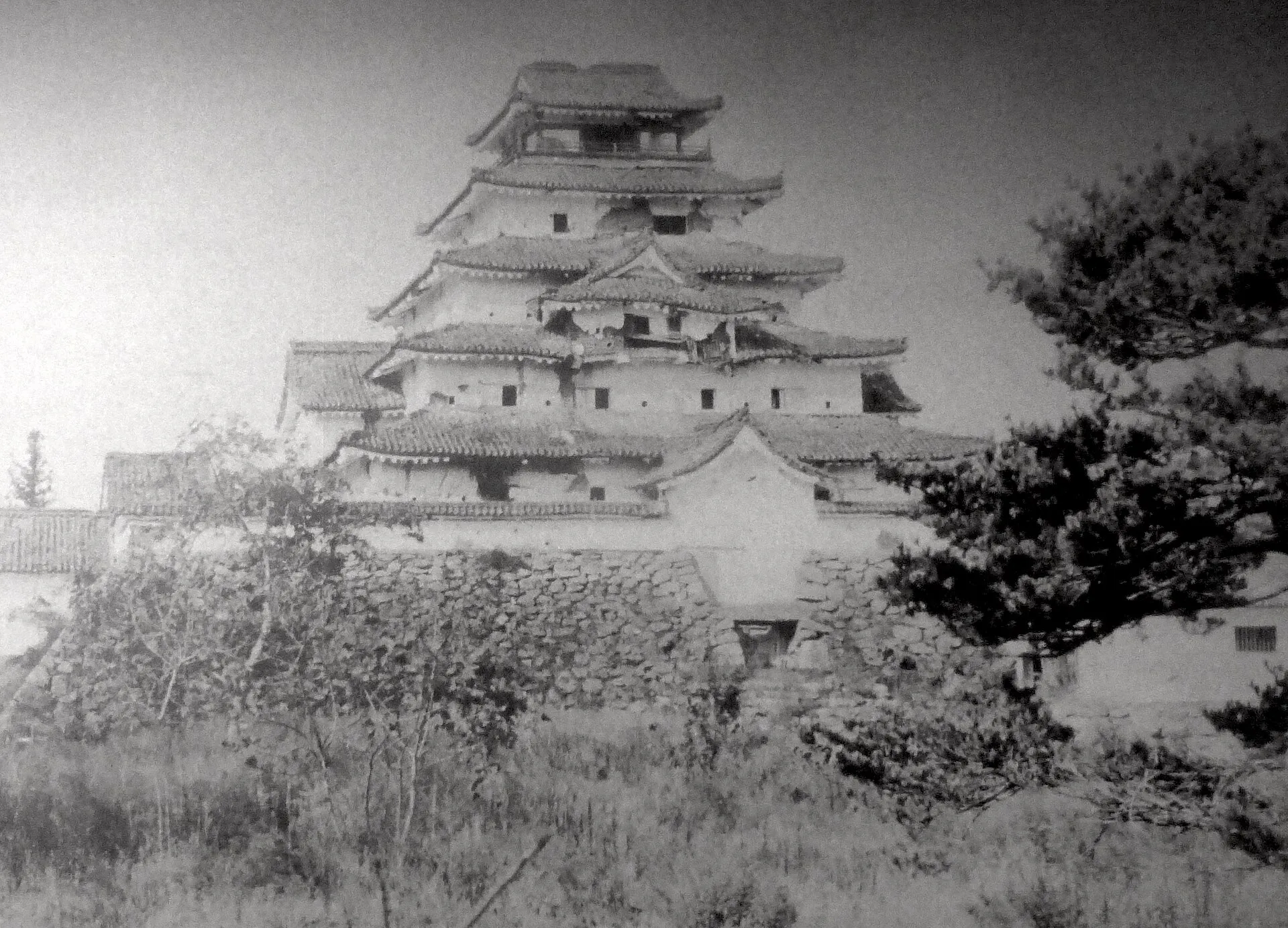
That photograph is the single most useful thing in this article. It is the keep at Tsuruga Castle in 1868, after the siege: plaster shot off, roofs broken, and standing. The building survived the war. It was pulled down in 1874 by the Meiji government, which is a different thing from being destroyed in it, and the distinction matters because almost every English account blurs the two.
Tsuruga Castle 鶴ヶ城
Aizu-Wakamatsu, fukushima
The stone walls and moats of the castle that held out for a month in the autumn of 1868, and a keep rebuilt in concrete in 1965 with a museum inside it. The red-tiled roof it wears now was put on in 2011, which is what it had before the Meiji government pulled the original down. The tea house Rinkaku, in the grounds, is a real survival: it was moved out of the castle to save it and brought back in 1990.
Getting there: Twenty minutes from Aizu-Wakamatsu Station on the Haikara-san loop bus. Open 8:30 to 17:00 all year, last entry 16:30. Four hundred and ten yen for the keep, five hundred and twenty with the tea house.
What to know first: What you climb is a 1965 reconstruction. The thing worth looking at before you go in is the photograph of the keep taken in 1868, shot through and standing: the building was still there after the siege, and it was the government that removed it in 1874, not the war.
What you climb today is concrete, poured in 1965. The stone walls and the moats are real, the red-tiled roof it wears now is a 2011 restoration of what the original had, and the tea house in the grounds is a genuine survival — taken out of the castle to save it from the demolition and brought back in 1990.
Part 2 — The hill, and the thing that happened on it
Iimoriyama 飯盛山
Aizu-Wakamatsu, fukushima
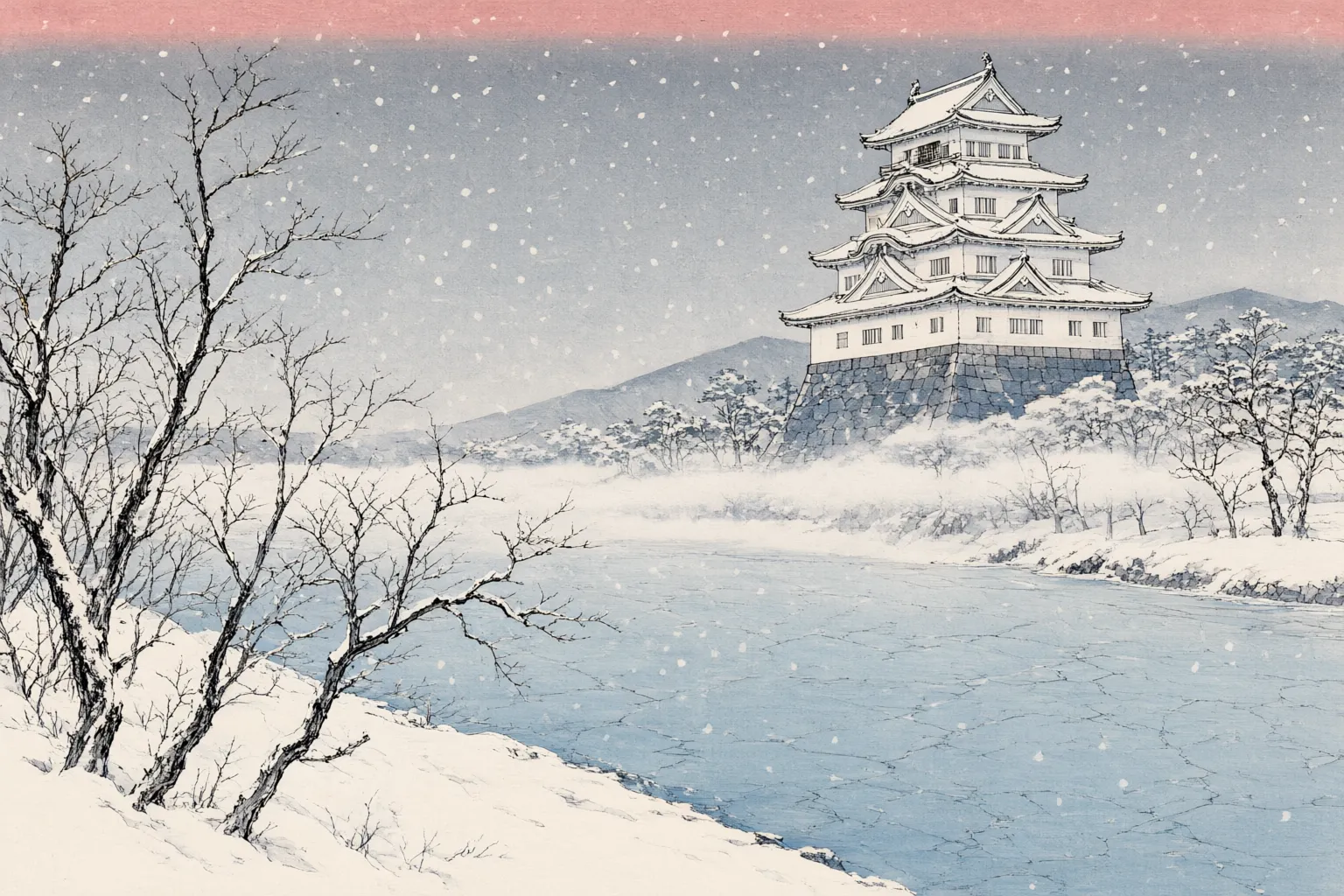
The hillside where nineteen teenage members of the Byakkotai killed themselves on seeing smoke over the town, and their graves. Sazaedo stands on the same slope — a hexagonal timber hall of 1796 with a double-helix ramp inside, so that nobody going up ever meets anybody coming down. It is an Important Cultural Property and there is nothing else quite like it.
Getting there: Five minutes on foot from Iimoriyama-shita on the loop bus from Aizu-Wakamatsu Station. The hill and the graves are free and open; there are 183 steps, with a paid moving slope beside them. Sazaedo is four hundred yen, roughly 8:15 to sunset from April to December and 9:00 to 16:00 in the winter.
What to know first: Published hours for Sazaedo differ between listings, and the hill's own opening is quoted both as always open and as 8:15 to sunset. Treat sunset as the limit in practice and go in the morning.
Nineteen boys of the Byakkotai, the reserve unit of sixteen- and seventeen-year-olds, came back over Iimoriyama during the siege, saw smoke rising over the town, believed the castle had fallen, and killed themselves. The castle had not fallen. It held for most of another month.
One of them was cut down and survived, which is the only reason anybody knows what they thought they were looking at.
On the same slope is Sazaedo, which has nothing to do with the war and is worth the climb anyway: a hexagonal timber hall of 1796 built as a double helix, so that the ramp up and the ramp down never cross and nobody going up meets anybody coming down. There is nothing else like it in Japan.
Aizu Bukeyashiki 会津武家屋敷
Aizu-Wakamatsu, fukushima
A reconstruction of the residence of Saigo Tanomo, chief retainer of Aizu, thirty-eight rooms of it, with genuinely old buildings moved here from elsewhere in the domain around it. The room where twenty-one members of his household killed themselves as the government army entered the town is staged with figures.
Getting there: Fifteen minutes from Aizu-Wakamatsu Station on the Akabe loop bus, stop Aizu Bukeyashiki-mae. Open 8:30 to 17:00 from April to November and 9:00 to 16:30 from December to March. Parking is free.
What to know first: The main house is a 1975 reconstruction, not a survival, and the staged suicide room is exactly as uncomfortable as it sounds. Current listings give a thousand yen for adults; the 850 yen figure that circulates widely is from 2017.
Be warned what the Bukeyashiki is. The main house is a 1975 reconstruction of the chief retainer’s residence, and the room where twenty-one women and children of the household killed themselves as the army came into the town is staged with figures. It is not a subtle experience. Some of the buildings moved here from elsewhere in the domain are real.
Part 3 — Hakodate, where it actually stopped
Goryokaku 五稜郭
Hakodate, hokkaido
The star fort where the war actually ended in May 1869, its earthworks and water moat intact and laid out as a public park, with the magistrate's hall inside rebuilt in timber in 2010 to the original drawings. The tower outside it exists to show you the shape from above, which is the only way the shape reads.
Getting there: Fifteen minutes on foot from Goryokaku-koen-mae tram stop. The fort and the park are free and open. The tower runs 9:00 to 18:00, last observation tickets 17:50.
What to know first: The tower operator has announced that the observation deck's admission changes on 1 April 2027 and has not published the new figure, so any price you read for it now — including in guides written this year — may be wrong by the time you go. Exterior painting on the tower was scheduled from May to November 2026 with the tower staying open throughout.
Enomoto Takeaki took the shogunate’s fleet north, declared a republic in Hakodate in December 1868 with himself elected president, and held out in the star fort until May 1869. The fort is the best-preserved thing the war left: earthworks and a water moat laid out as a public park, free and open, with the magistrate’s hall inside rebuilt in timber in 2010 to the original drawings.
The shape only reads from above, which is what the tower next to it is for. Note that the tower’s admission changes on 1 April 2027 and the operator has not published the new figure — so any price you read for it, including in guides written this year, may be wrong by the time you go.
Part 4 — Fact and legend
Documented: the Byakkotai saw smoke, not a fallen castle. The castle held for weeks after they died. What they saw burning was the town.
Documented, and usually told backwards: the keep. It came through the siege and was demolished six years later by the new government, along with most of the castles in Japan. The war did not knock it down.
Retold, and worth being careful with: Aizu as pure victim. The domain was not a bystander; Katamori’s men had spent years policing Kyoto with a heavy hand, and the Satsuma and Choshu soldiers who came over the passes in 1868 had reasons of their own that were not invented for the occasion. The nineteen boys on Iimoriyama are still nineteen boys. Both things are true, and Aizu’s own museums are better at the first half than the second.
Not settled: the body count at Toba-Fushimi, and most other numbers in this war. Figures in English-language accounts are copied between books with more confidence than the sources support. If a number matters to you, it is worth finding out where it came from.
Part 5 — The route
Aizu-Wakamatsu is the trip. The castle, Iimoriyama and the Bukeyashiki are all inside the city and all on the same loop bus, which is two days at a comfortable pace or a long one if you must. From Tokyo it is about three hours — Shinkansen to Koriyama, then the Ban-etsu West line.
Hakodate is not part of that trip and anybody telling you otherwise has not looked at a map. Toba-Fushimi is a short train ride out of Kyoto and is mostly markers and plaques.
Check rooms in Aizu-Wakamatsu for your dates
Before you go
Tsuruga Castle: 8:30 to 17:00 all year, last entry 16:30. Four hundred and ten yen for the keep, five hundred and twenty including the tea house — take the tea house, it is the older thing.
Iimoriyama: the hill and the graves are free and open. There are 183 steps and a paid moving slope beside them. Sazaedo is four hundred yen, roughly 8:15 to sunset from April to December and 9:00 to 16:00 in winter; published hours differ between listings, so treat sunset as the limit and go in the morning.
Aizu Bukeyashiki: 8:30 to 17:00 April to November, 9:00 to 16:30 December to March. Current listings say a thousand yen for adults. The 850 yen figure still circulating is from 2017.
Goryokaku: fort and park free and open. Tower 9:00 to 18:00, last observation tickets 17:50, price changing on 1 April 2027.
The stay list below is the city, not the hot spring — Rakuten has no separate area for Higashiyama — so it mixes ryokan up the valley with business hotels in town. The picks say which is which, because the choice between them is really a choice about whether you came for the bath or for the war.
Where to Stay: Aizu-Wakamatsu
Two hot spring villages in the hills behind a castle town, and business hotels in the town. Which you want depends on whether you came for the bath or the war.
Full guide: Aizu-Wakamatsu — what to expect, how to get there, and which inns are bookable
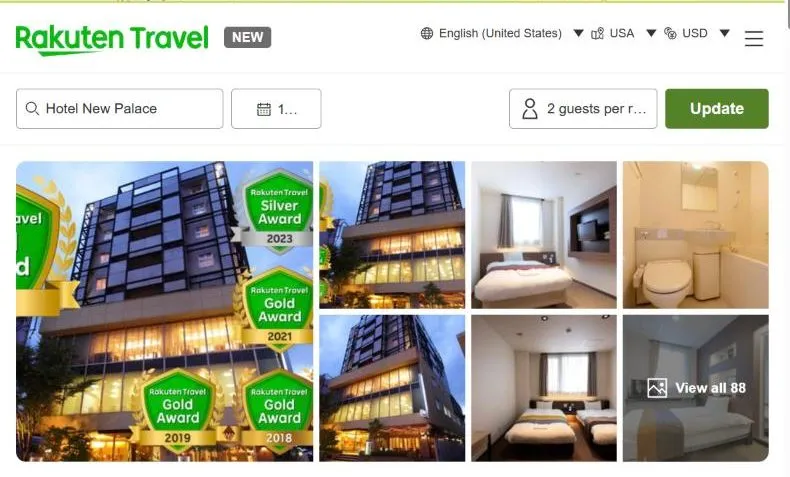 Hotel New Palacefrom $99
The one in town rather than up the valley, at half the price of the ryokan, with 4.2 across two hundred and sixty-eight reviews. No hot spring. If you want two days on the battlefield sites and do not care about the bath, this is the honest choice.
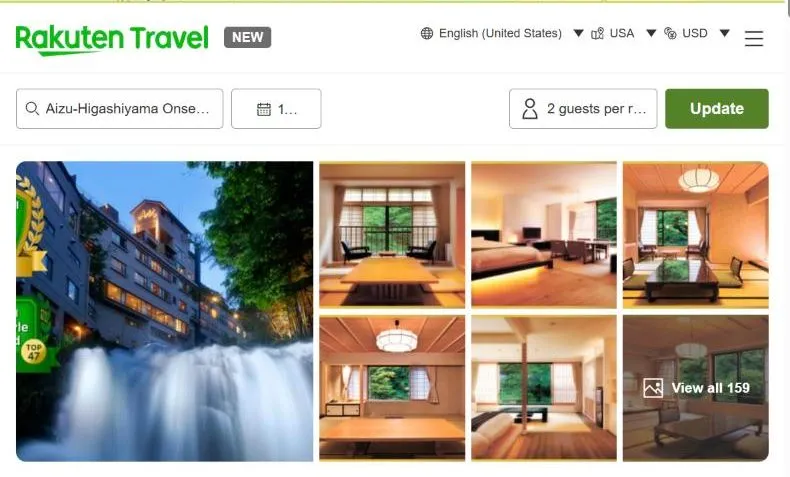 Aizu-Higashiyama Onsen Shosuke no Yado Takinoyufrom $198
The best-evidenced number in Aizu by a long way — 4.2 across four hundred and twenty-six reviews, where nothing else in the valley has more than three hundred and thirty. Higashiyama proper, on the river, nine minutes from the town by car.
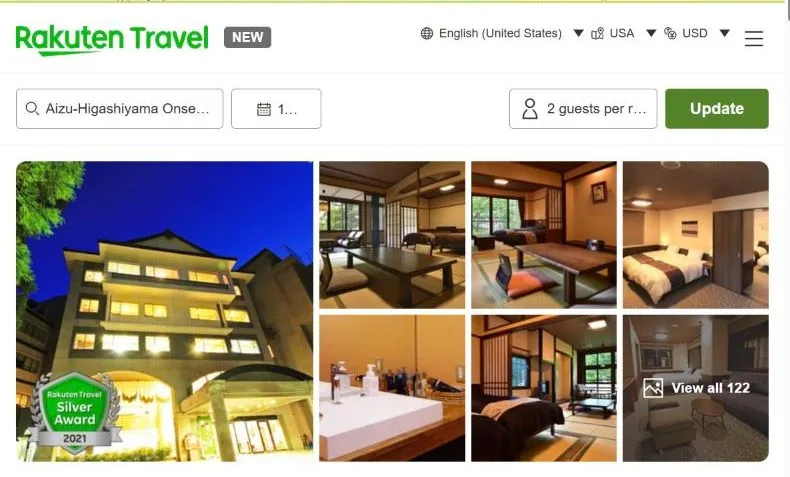 Aizu-Higashiyama Onsen Kutsurogijuku Shintakifrom $263
The highest score here that rests on a real sample: 4.6 from a hundred and twenty-five. It is the dear end of the valley and it is further up it, so treat this as the night you are spending on the inn rather than on the castle.
Inn images are screenshots of each inn's own page on Rakuten Travel, captured 2026-10-27. The photographs in them belong to the inns; pages and prices change.
The other 24 inns in Aizu-Wakamatsu
- Hotel Takakoroom only · from $55
- Aizunanukamachi Innroom only · from $57
- Fujimi Ryokanroom only · from $69
- Aizu Tsuruya Hotelroom only · from $72
- Ashinomaki Onsen Fudokan Koya No Yuroom only · from $75
- Higashiyama Onsen Higashiyama Park Hotel Shinfugetsuroom only · from $86
- Nakamachi Fuji Grand Hotelroom only · from $87
- Higashiyama Onsen Motoyu Arimayabreakfast included · from $90
- Yukkura Innroom only · from $92
- Aizu-Higashiyama Onsen Irori no Yado Ashinaroom only · from $95
- Hotel Route-Inn Aizuwakamatsubreakfast included · from $97
- Hotel Osakayabreakfast included · from $101
- Aizu-Higashiyama Onsen Tsuki no Akarifrom $106
- Aizu-Higashiyama Onsen Haratakiroom only · from $125
- Oedo Onsen Monogatari Higashiyama Grand Hotelroom only · from $141
- Aizu Ashinomaki Onsen Marumine Kanko Hotelroom only · from $142
- Aizu-Higashiyama Onsen Konjakuteiroom only · from $175
- Oedo Onsen Monogatari Aizuroom only · from $181
- Tagotobreakfast included · from $195
- Aizu-Higashiyama Onsen Kutsurogijuku Chiyotakifrom $251
- Aizu Ashinomaki Onsen Okawasofrom $278
- Aizu Higashiyama Onsen On-yado Toho (Orix Hotels)from $296
- Aizu-Higashiyama Onsen Hanare Matsushimakakudinner and breakfast · from $318
- Aizu Ashinomaki Onsen Keiryu no Yado Keizandinner and breakfast · from $320
Prices are the lowest seen for two people, one night, on 2026-12-11, checked 2026-10-27. They move with the date — treat them as a rough floor, not a quote. Japanese inns are listed under romanised names that often differ from the signs outside them, so these link straight to the inn rather than to a search. What the booking page looks like.
See what is available in Aizu-Wakamatsu
27 inns were bookable in English on the date checked. Availability shifts: a check four months earlier returned a partly different list, so this is what was open then rather than a fixed roster. Availability moves quickly at smaller inns, and weekends book out first.