Sakamoto Ryoma: A Deserter Who Brokered the Restoration
Katsurahama, the street he was born in, and the castle he ran away from
Sakamoto Ryoma was a goshi — the lowest rank of Tosa samurai, a class the domain’s own hierarchy barely counted. He left the domain without permission in 1862, which was a capital offence. Five years later Satsuma and Choshu, who had spent a decade trying to kill each other, were allies, and the shogunate was finished, and he had had a hand in both.
He was murdered in Kyoto in December 1867, aged thirty-one, about six weeks after Yoshinobu gave the office back.
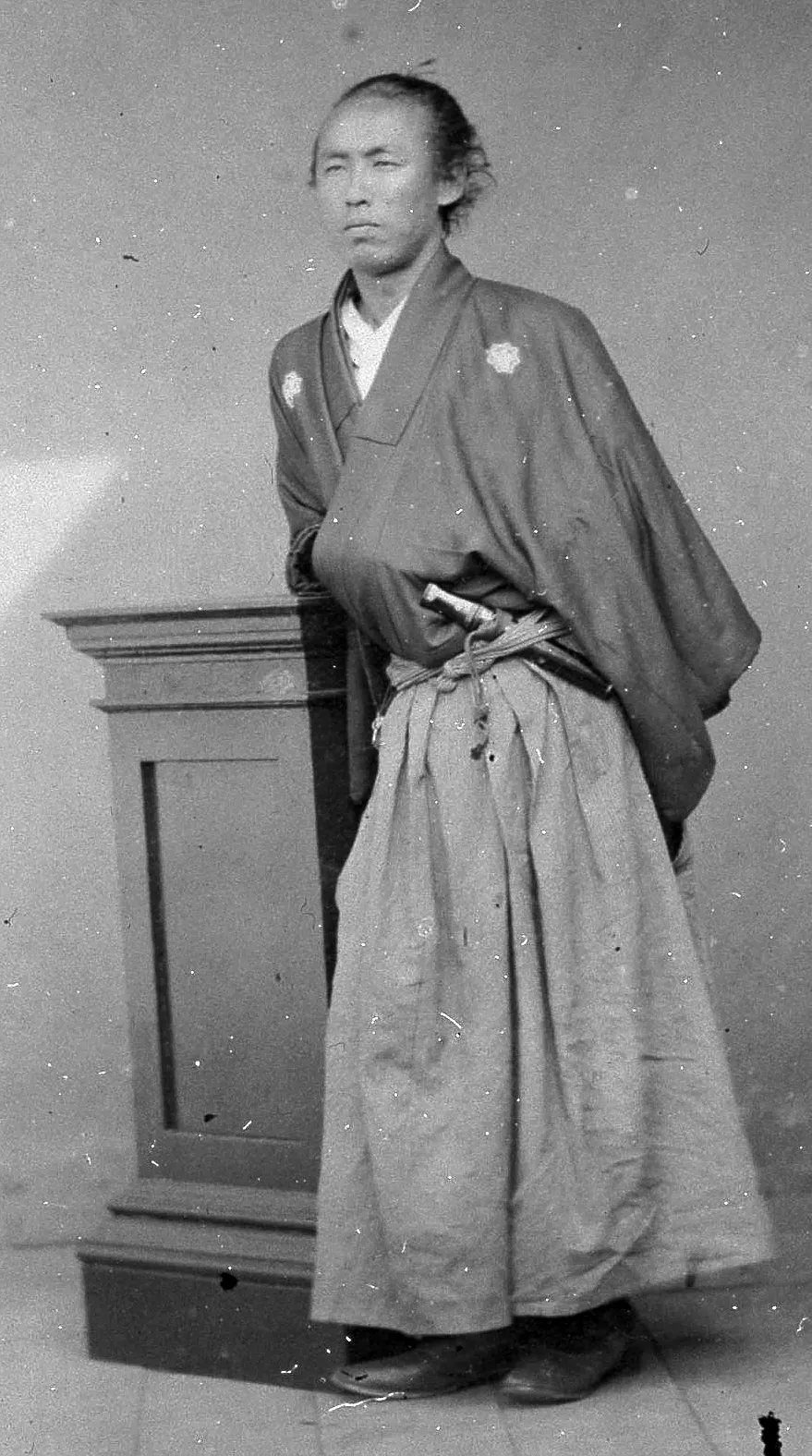
The boots. That is a Tosa samurai in a crested haori with a sword at his waist and a pair of Western leather boots on his feet, standing in Ueno Hikoma’s studio in 1866 or 1867. You do not need the biography.
It is also worth putting beside the other guide written here the same day. Saigo Takamori, his ally and near-contemporary, was never photographed once in his life, and the face everyone knows is a drawing made six years after he died. Ryoma sat down in front of a camera and produced what is probably the best-known photograph of any Japanese person of that century.
Part 1 — The street, and the castle above it
Ryoma's Birthplace 坂本龍馬誕生地
Kochi, kochi
A stone in the Kami-machi street where the house stood, and a block away the city's museum of the quarter he grew up in, which is about the neighbourhood as much as the man. Nothing of the house itself is left.
Getting there: Kami-machi 1-chome on the tram from Kochi Station, then a short walk. The stone is free and outdoors. The museum is open 8:00 to 19:00 with last entry at 18:30, every day, three hundred and seventy yen, free for school age and under.
What to know first: Those opening hours are not a misprint and are the most useful thing on this page: it opens at eight in the morning and shuts at seven in the evening, which makes it the one Ryoma site you can fit around everything else. Older listings still give three hundred yen.
He was born in Kami-machi in 1836 into a family of some money and no standing — the Sakamoto were merchants who had bought their way into the lowest samurai rank. Nothing of the house survives. There is a stone where it stood, and a block away the city keeps a small museum about the quarter rather than about the man, which is the more honest subject.
Note its hours, which are the most useful fact on this page: 8:00 to 19:00, every day. Nothing else in Kochi opens at eight in the morning.
Kochi Castle 高知城
Kochi, kochi
One of the twelve keeps in Japan that were never rebuilt, and the only one that still has its lord's residence standing attached to it — the Kaitokukan. The Yamauchi built it after the Chosokabe were dispossessed and ran Tosa from it until 1871. It is the authority Ryoma walked out on when he left the domain without leave in 1862.
Getting there: Ten minutes on foot from Kochi Station, or the tram to Kochijo-mae. Open 9:00 to 17:00, last entry 16:30, closed 26 December to 1 January. Five hundred yen for eighteen and over, free under eighteen.
What to know first: The castle history museum across the road is a separate ticket with its own hours and a combined ticket available; sources disagree on its closing days over the new year, giving both 26 to 31 December and 27 December to 1 January.
And above the town is the thing he walked out on. Kochi Castle is one of twelve keeps in Japan never rebuilt, and the only one that still has the lord’s residence standing attached to it. The Yamauchi built it after the Chosokabe were dispossessed in 1600, imported their own retainers, and put the old Tosa families — Ryoma’s among them — permanently underneath them.
That two-tier arrangement, two and a half centuries old by 1862, is the thing he was actually running away from.
Part 2 — Katsurahama
Katsurahama 桂浜
Kochi, kochi
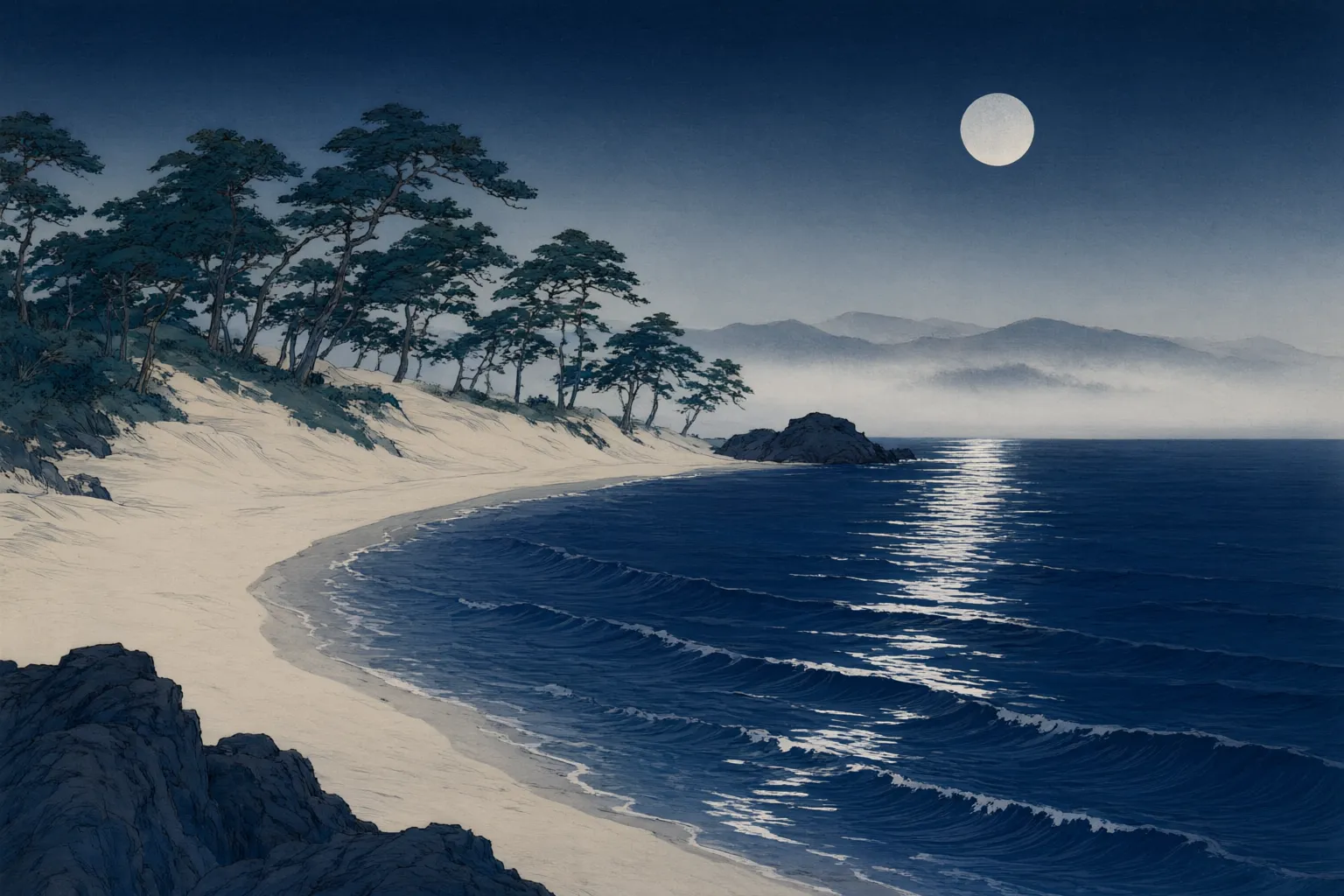
A curved beach between two headlands with a pine wood behind it, the bronze of Ryoma standing at the top of the slope looking out to sea since 1928, and the prefecture's Sakamoto Ryoma museum on the cliff above. The beach is a moon-viewing place and has been one in local song for longer than the statue has stood on it.
Getting there: Forty minutes by bus from Kochi Station. The beach and the statue are free. The museum is 9:00 to 17:00, last entry 16:30, open all year.
What to know first: The museum's admission depends on what is on: nine hundred yen while a special exhibition is running and five hundred when only the permanent display is, free for school age and under. Nobody publishes which is running on the day you want, so ring 088-841-0001 if the difference matters. Swimming at Katsurahama is not allowed — the current is the reason, and the signs mean it.
The statue has stood at the top of the slope since 1928, looking out to sea, and it is the picture of Kochi. The beach below it is a moon-viewing place and was one in local song long before anybody put a bronze on it.
Do not swim. The current is why, the signs say so, and people ignore them every year.
Urado Castle Site 浦戸城跡
Kochi, kochi
Very little: the hill above Katsurahama where Motochika moved his seat in 1591, a fragment of wall and a marker. The Sakamoto Ryoma Memorial Museum now occupies the site.
Getting there: Bus from Kochi Station to Katsurahama, about forty minutes.
What to know first: The famous bronze statue above the beach is Sakamoto Ryoma, not Chosokabe Motochika — three centuries apart, and routinely conflated. Motochika's own statue is at Oko.
The same headland holds the site of Urado Castle, which is where the Chosokabe ended up before the Yamauchi arrived and took everything — so the two stories on this site that are set in Kochi meet on one beach, two hundred and sixty years apart.
Check rooms in Kochi for your dates
Part 3 — What he actually did, and what he is said to have done
Documented: the Satsuma-Choshu alliance, January 1866. Satsuma had helped crush Choshu in 1864. Ryoma, with Nakaoka Shintaro, worked the back channel that got Kido Takayoshi and Saigo Takamori into the same room in Kyoto and the agreement signed. Without it there is no coalition and probably no restoration. This is the thing he is for, and it holds up.
Documented: he was Katsu Kaishu’s student. He went to kill Katsu in 1862, by the usual account, and left as his pupil — then helped run the naval school Katsu set up at Kobe. The guide to Katsu on this site is the other end of that relationship.
Partly documented: the Senchu Hassaku. The eight-point plan said to have been drafted aboard ship in 1867, and said to be the skeleton of the restoration settlement. It exists; how directly it shaped what followed is argued about far more quietly than the popular version admits.
Retold, and mostly Shiba Ryotaro: Ryoma the lone visionary. The modern Ryoma — the free spirit who saw the future while everyone else bickered — is substantially the Ryoma of Ryoma ga Yuku, a novel serialised from 1962. It is a wonderful book. It is also the reason this man outranks, in popular memory, several people who did more.
Not settled: who killed him. The Mimawarigumi is the usual answer and was claimed at the time; the Shinsengumi were long blamed; some accounts point further up. Nobody was ever tried. The site in Kyoto is a marker outside a shop.
Part 4 — The route
Everything here is in Kochi and most of it is on one tram line. The birthplace stone and its museum in the morning, the castle in the middle of the day, and Katsurahama in the afternoon — forty minutes out by bus, and the light on the beach is better late.
Kyoto is where he died and is a different trip entirely: the Omiya marker in Kawaramachi, and the Teradaya in Fushimi where he was attacked in 1866 and got out through a window.
Before you go
Kochi Castle: 9:00 to 17:00, last entry 16:30, closed 26 December to 1 January, five hundred yen for eighteen and over and free under. The castle history museum opposite is a separate ticket with a combined option, and sources disagree about its new-year closing days.
The Sakamoto Ryoma Memorial Museum at Katsurahama: 9:00 to 17:00, last entry 16:30, open all year. The admission depends on what is on — nine hundred yen during a special exhibition and five hundred otherwise, free for school age and under. Nobody publishes which is running on a given day, so ring 088-841-0001 if five hundred yen a head matters to you.
Ryoma’s Birthplace Museum: 8:00 to 19:00, last entry 18:30, every day, three hundred and seventy yen. Older listings still say three hundred.
The beach, the statue, the birthplace stone and the Urado site are free.
Kochi has forty-four properties bookable in English and unusually honest review counts for a city list. They are hotels rather than ryokan; the one exception is in the grounds of a former Yamauchi residence, which given the above is either perfect or tactless.
Where to Stay: Kochi
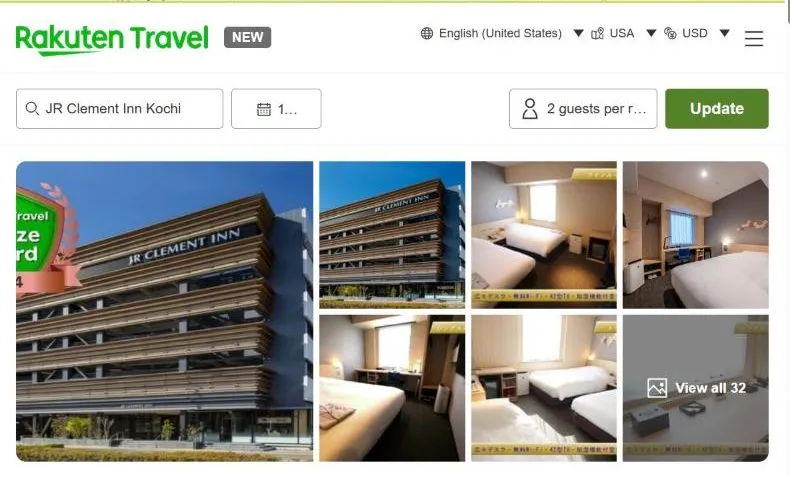 JR Clement Inn Kochifrom $91
The value pick, and the best-evidenced number on the island as far as this file goes: 4.4 across two hundred and thirty-nine reviews, at the station, which is where the bus to Oko leaves from.
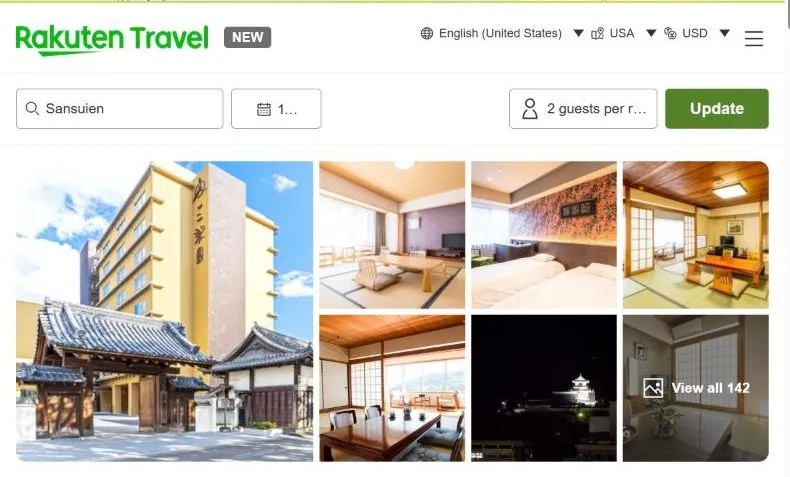 Sansuienfrom $97
The one with a hot spring and a garden, in the grounds of what was a Yamauchi residence — the house that replaced the Chosokabe. 4.3 across a hundred and thirty reviews.
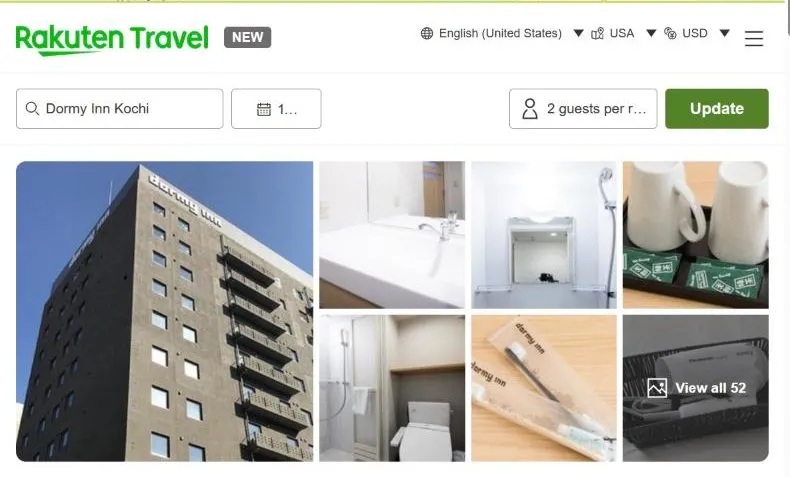 Dormy Inn Kochifrom $126
The reliable middle: a large public bath, 4.4 from a hundred and seventy-six reviews, and five minutes from the Harimayabashi trams.
Inn images are screenshots of each inn's own page on Rakuten Travel, captured 2026-10-27. The photographs in them belong to the inns; pages and prices change.
The other 4 inns in Kochi
Prices are the lowest seen for two people, one night, on 2026-12-11, checked 2026-10-26. They move with the date — treat them as a rough floor, not a quote. Japanese inns are listed under romanised names that often differ from the signs outside them, so these link straight to the inn rather than to a search. What the booking page looks like.
See what is available in Kochi
7 inns were bookable in English on the date checked. Availability shifts: a check four months earlier returned a partly different list, so this is what was open then rather than a fixed roster. Availability moves quickly at smaller inns, and weekends book out first.